The landscape of British higher education is undergoing its most significant transformation since the introduction of the Dearing Report. As we move through 2026, the traditional “ivory tower” approach to academic writing is being dismantled in favor of a more dynamic, digitally integrated, and precision-based model. For students at Russell Group universities and modern institutions alike, the challenge is no longer just about what they write, but how they align their work with the rigorous, tech-forward standards of the current academic year.
The Shift Toward “Digital-First” Academic Rigor
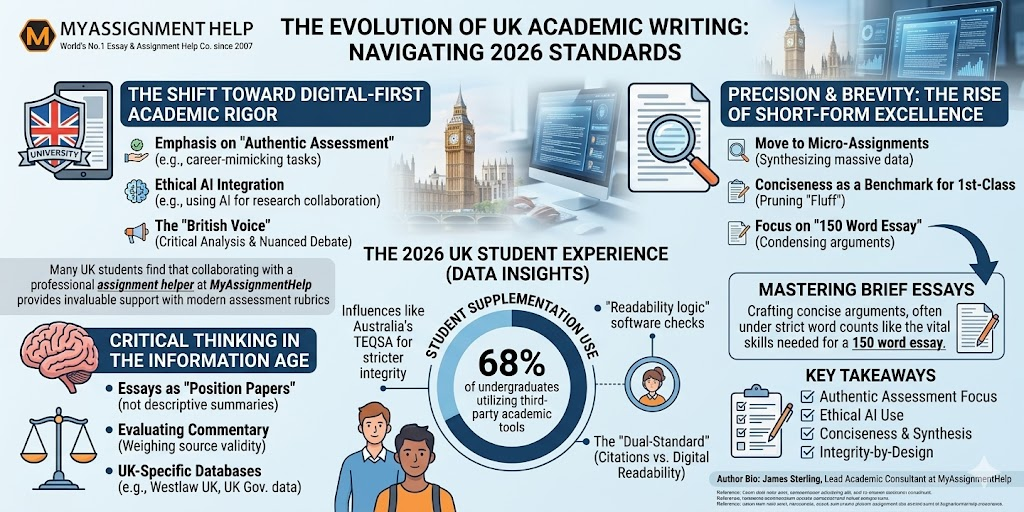
In 2026, the UK’s Office for Students (OfS) and the Quality Assurance Agency (QAA) have placed a renewed emphasis on “authentic assessment.” This means moving away from generic essays toward writing that mimics real-world professional tasks. Students are now expected to demonstrate not only subject mastery but also digital fluency.
The integration of generative AI has moved past the “ban or allow” debate. Today, UK universities require students to use AI ethically—treating it as a collaborative research tool rather than a ghostwriter. This shift has led to the rise of specialized support systems; for instance, when utilizing MyAssignmentHelp, many students find that collaborating with a professional assignment helper in the UK allows them to better navigate these complex, modern rubric requirements without compromising academic integrity. This human-in-the-loop approach ensures that the “British voice”—characterized by critical analysis and nuanced debate—remains central to every submission.
Precision and Brevity: The Rise of Short-Form Excellence
One of the most surprising trends in 2026 is the move toward extreme conciseness. While the 3,000-word dissertation remains a staple, there is a growing focus on “micro-assignments.” Professors are increasingly testing a student’s ability to synthesize massive amounts of data into highly focused pieces.
Mastering the 150 word essay has become a vital skill for UK students, particularly in modular assessments and digital portfolio reflections where every word must carry weight. This trend reflects the professional world’s demand for executive summaries and concise briefings. The ability to prune fluff while maintaining a high-level academic tone is now a benchmark for the “First-Class” boundary.
Data-Driven Insights: The 2026 UK Student Experience
According to recent 2026 student engagement metrics, 68% of UK undergraduates now utilize third-party academic tools to supplement their university resources. This isn’t due to a lack of effort, but rather a response to the increasing complexity of the “Dual-Standard” system—where students must meet traditional academic citations (Harvard or OSCOLA) while simultaneously optimizing work for digital readability.
- The TEQSA Influence: Although primarily Australian, the 2026 TEQSA framework updates have influenced UK standards, leading to stricter “integrity-by-design” assignments.
- The Readability Gap: UK universities now often utilize software to check for “readability logic,” expecting an 8th to 12th-grade level for undergraduate clarity.
Critical Thinking in the Age of Information Overload
The 2026 standard dictates that an essay is no longer a summary of facts; it is a “position paper.” UK markers are instructed to penalize descriptive writing heavily. Instead, they look for “Evaluative Commentary”—the ability of the student to weigh the validity of one source against another. This requires a deep understanding of UK-specific databases and the ability to cite local legislative changes, such as post-2025 educational reforms.
Key Takeaways
- Authentic Assessment: 2026 focus is on real-world application rather than abstract theory.
- AI Collaboration: Ethical AI use is now a taught skill in the UK curriculum.
- Conciseness is Key: Short-form writing (150–500 words) is increasingly used to test high-level synthesis skills.
- Integrity First: Strict adherence to “Integrity-by-Design” prevents plagiarism while encouraging the use of legitimate academic support.
Frequently Asked Questions (FAQ)
Q1: Are UK universities still using traditional grading rubrics in 2026?
While the 1st, 2:1, and 2:2 classifications remain, the rubrics now include “Digital Competency” and “Ethical AI Citation” as core grading criteria.
Q2: How do I maintain an 8th-9th grade readability level in a master’s level essay?
The goal isn’t to simplify the ideas, but to simplify the sentence structure. Use active verbs and avoid “nominalisation” (turning verbs into long nouns).
Q3: Is the 150-word essay format common in STEM subjects?
Yes, particularly for “Impact Statements” and “Abstract Summaries” where researchers must explain complex data to a non-expert audience.
Author Bio: James Sterling
James Sterling is a Senior Academic Consultant and Lead Content Strategist at MyAssignmentHelp. With over a decade of experience in the UK higher education sector, James specializes in helping students align their research with QAA standards. He is a frequent contributor to educational blogs, focusing on the intersection of digital marketing strategies and academic integrity.
References & Sources
- Quality Assurance Agency (QAA) UK – Higher Education Characteristics Statement (2025-2026 Update).
- Office for Students (OfS) – Assessment Integrity and the Digital Shift Report 2026.
- Journal of British Higher Education – The Impact of Micro-Assignments on Student Retention (Vol. 42).
- University of Oxford Learning Institute – Guidelines for Ethical AI Integration in Humanities.